On March 10, 2026, a distinguished group of religious leaders, scholars, and public intellectuals will gather in Rome for the interfaith event
“AI & Human Freedom: Jewish, Christian and Muslim Perspectives.”
The event will take place at the renowned Centro Pro Unione, one of the world’s leading institutes dedicated to ecumenical and interreligious dialogue.
The Center has been operating since 1969 and serves as a hub for ecumenical and interfaith leaders who come to Rome.
This gathering comes at a decisive cultural moment. The accelerating rise of artificial intelligence is reshaping nearly every dimension of human life—from communication and labor to governance, ethics, and spirituality.
While AI technologies promise new possibilities for innovation and connection, they also raise profound questions about human freedom, moral agency, and dignity.
The March 10 event is designed specifically for an interfaith audience, bringing together Jewish, Christian, and Muslim voices to reflect on how the Abrahamic traditions can contribute to a shared moral and spiritual framework for the age of artificial intelligence.
Building on a Strong Foundation
This initiative follows a major international conference – “AI, Human Dignity, and the Free Society” – hosted in December by the Acton Institute at the Pontifical Gregorian University in Rome, which drew hundreds of attendees from around the world.
That landmark gathering demonstrated the urgency of engaging AI not merely as a technological development but as a cultural and anthropological turning point.
In the rapidly expanding global debate on artificial intelligence, a significant gap remains: few platforms meaningfully connect AI ethics with the deep moral and anthropological insights of Jewish, Christian, and Muslim traditions.
The March 10 event intends to address this unmet need by bringing interreligious voices into a conversation too often dominated by technologists and policy experts alone. It builds upon the December momentum but moves intentionally into the interreligious sphere.
In doing so, the Collins Center is spearheading crucial work in the field of interfaith dialogue by organizing high-level conversations on artificial intelligence—an issue that transcends confessional boundaries and demands collaborative moral reflection.
The long-term vision is to develop a series of similar events in cities where the Collins Center has previously hosted programs—such as London, Glasgow, and Madrid—and potentially in Budapest, Dublin and Tirana, where strong institutional relationships already exist.
By expanding geographically, the Center aims to cultivate a sustained, international interfaith conversation on AI and human freedom.
Strong Public Interest and Diverse Participation
The remarkable level of interest in this initiative underscores its urgency and relevance.
The event is already completely sold out a full month before the scheduled date, and a growing waiting list has formed. Among the registered participants are professors and PhD students from Rome’s Pontifical Universities, alongside entrepreneurs, professionals, and lay leaders representing various NGOs and secular institutes.
This diverse audience reflects a broad recognition that the ethical and spiritual implications of artificial intelligence extend far beyond academia or theology—they touch business, civil society, policymaking, and everyday life.
Core Themes of the Discussion
The interfaith gathering will explore several critical questions:
How do Jewish, Christian, and Muslim traditions understand human freedom and moral responsibility in a world increasingly shaped by algorithms and automation?
What guidance do sacred texts and long-standing ethical traditions offer to ensure that technology serves—rather than supplants—human dignity?
How can interreligious cooperation help shape a humane and ethical vision for AI in contemporary society?
By placing theology, philosophy, and lived religious experience into conversation with technological innovation, the event seeks to articulate a moral compass for the digital age.
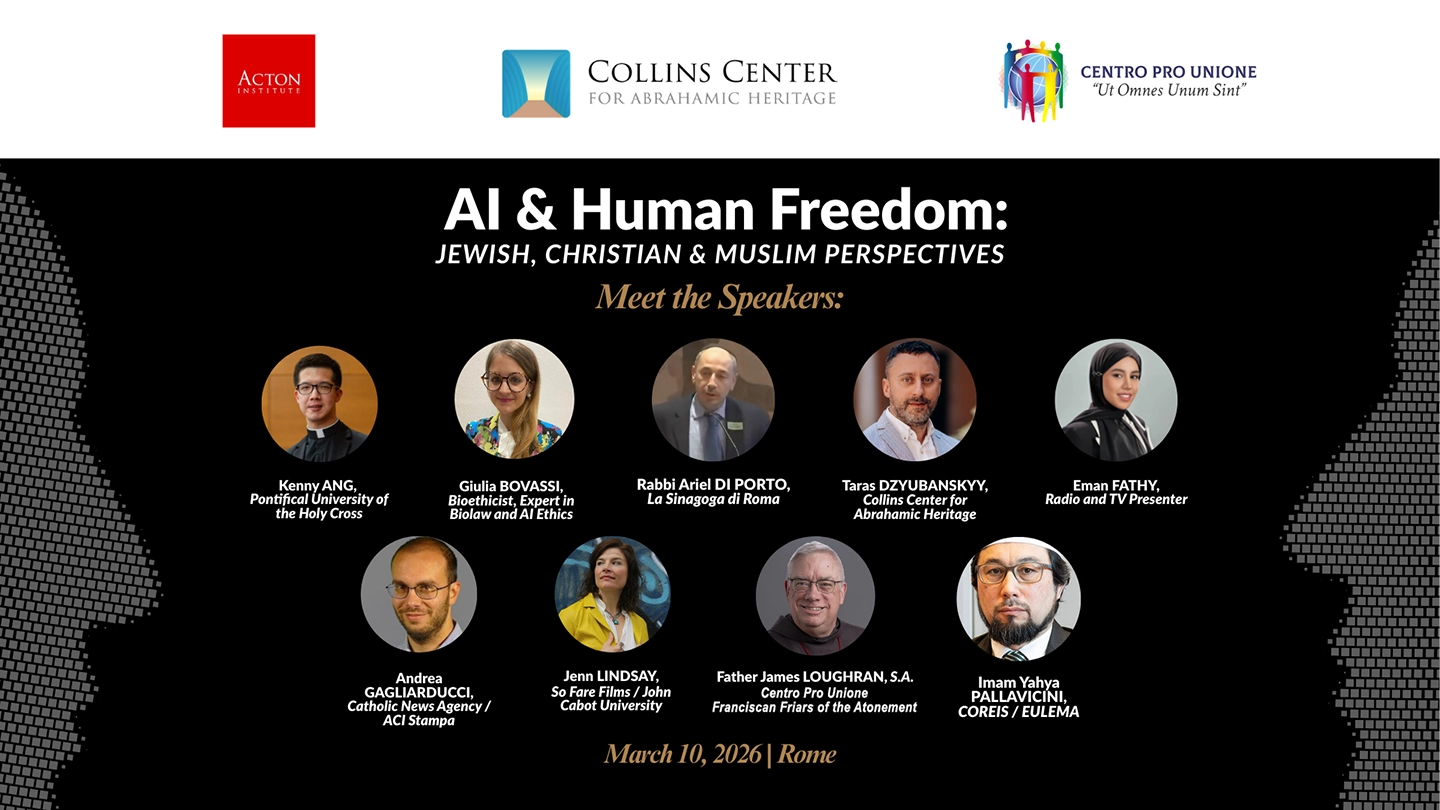
Rabbi Ariel Deporto
Rav Ariel Di Porto, a prominent rabbinic leader serving the historic Jewish community of Rome, one of the oldest Jewish communities in the world. Deeply engaged in education, pastoral leadership, and interreligious engagement, he brings a rooted yet outward-looking Jewish perspective to contemporary ethical debates, including the moral implications of AI.
Jenn Lindsay
Dr. Jenn Lindsay, CEO of So Fare Films and Lecturer in Sociology at John Cabot University. A documentary filmmaker and social scientist specializing in religion, pluralism, and cultural conflict, she is the Producer/Director of the award-winning documentary Simulating Religious Violence, which follows scholars and scientists using computational modeling to understand processes of religious radicalization. Her interdisciplinary expertise bridges academia, media, and public discourse, bringing a research-driven perspective to questions of religion and technology.
Giulia Bovassi
Giulia BOVASSI is a bioethicist engaged in academic research and institutional advisory work in the fields of bioethics, biolaw, and the ethics of Artificial Intelligence. She serves as Associate Researcher at the Faculty of Bioethics of Universidad Anáhuac (Mexico) and at the UNESCO Chair in Bioethics and Human Rights in Rome. She teaches in the Master’s Program in Global Bioethics at Universidad Anáhuac and is appointed Expert Member in Bioethics for the Regional Ethics Committee of the Marche Region (Italy) and serves as Expert Consultant on Bioethics and Social Affairs at the Chamber of Deputies of the Italian Republic (19th Legislature). She has also collaborated with the Italian Committee for Bioethics of the Presidency of the Council of Ministers and served as Consultant on AI Ethics to a Member of the European Parliament within the AIDA Committee (9th Legislature). In March 2024, she was invited to speak at the Headquarters of the United Nations in New York during the 68th session of the Commission on the Status of Women (CSW68), at the conference entitled “Too High a Cost: End Surrogacy Now. Preventing the Exploitation and Commodification of Women and Children.” Author of numerous scientific publications and three monographs, her research focuses on the foundations of bioethics, the legal implications of biomedical issues, and the anthropological challenges posed by neurotechnologies, digital technologies and Artificial Intelligence.
Kenny Ang
Prof. Kenny Ang, Research Professor in Dogmatic Theology at the Pontifical University of the Holy Cross. A specialist in Trinitarian theology, medieval thought, and Biblical Thomism, his research also explores the impact of artificial intelligence on theological inquiry and religious education. His contribution offers a systematic theological lens on questions of personhood, freedom, and human creativity.
Mariam Ali
A student of International Relations and a cultural commentator, Mariam Ali explores the intersection of faith, culture, and contemporary society. She has developed her expertise in interreligious dialogue through specialized programs including the “Emuna” high-level training at Luiss Guido Carli University. Leveraging her digital presence, she bridges the gap between academic research and public discourse to foster cross-cultural understanding and social cohesion.
Imam Yahya
Imam Yahya Pallavicini, Imam of the al-Wahid Mosque in Milan and Vice President of COREIS (the Islamic Religious Community of Italy). Chairman of EULEMA in Brussels and participant in high-level EU dialogues under Article 17 of the EU Treaties, he is a leading European Muslim voice on coexistence and religious freedom. His global engagement brings an Islamic ethical perspective to the conversation on technology and society.
Father James Loughran, S.A.
Father James Loughran, S.A., Director of the Centro Pro Unione. A priest of the Franciscan Friars of the Atonement, he has dedicated decades to fostering Christian unity and interfaith dialogue worldwide. His pastoral and theological experience ensures that the conversation remains grounded in lived spiritual realities.
Andrea Gagliarducci
Andrea Gagliarducci, a respected Vatican journalist and analyst known for his deep insight into Church affairs and global religious dynamics.
Taras Dzyubanskyy
Dr. Taras Dzyubanskyy is a theologian and Religious Liberty Fellow at the Collins Center for Abrahamic Heritage/Acton Institute and founder of the Libertas Center for Interreligious Dialogue. He holds a PhD in Theology from the Pontifical University of St. Thomas Aquinas and has served since 2012 as adviser on religious and ecumenical issues to the Mayor of Lviv.
An alumnus of the UNAOC Fellowship Program, he has developed global interfaith initiatives, including a Dialogue Fellowship Program in Ukraine, and teaches at the Ukrainian Catholic University and Adam Mickiewicz University in Poznan, Poland. Author of four books, he is dedicated to fostering interfaith and intercultural dialogue as a path to peace and understanding.